

Live video delivery

vidNT Multi‑CDN Stitching

One unbroken stream, stitched from the CDNs you already pay for.

vidNT sits above the CDNs you already have and answers one question, continuously: for this viewer, on this network, right now — which of your CDNs should serve the next segment?

Uses the CDNs you already pay for A decision per session, not a weight per region Out of your delivery path
Per-viewer routing

A weight per region answers a question nobody asked.

"Which CDN is best for Germany" is not a real question. The real one is "which CDN is best for this viewer, on this mobile network, in this city, during this event".

Region × network

Decisions are scored per geography and per access network, because a fibre viewer and a mobile viewer in the same city routinely need different answers.

Continuously re-scored

The engine re-ranks your CDNs on a short cycle from live signals — not from a table someone edited last quarter.

Explainable

Every decision carries the reason it was made. You can replay why a viewer went where they went.

Mid-stream stitching

We choose before the first segment — and keep choosing after it.

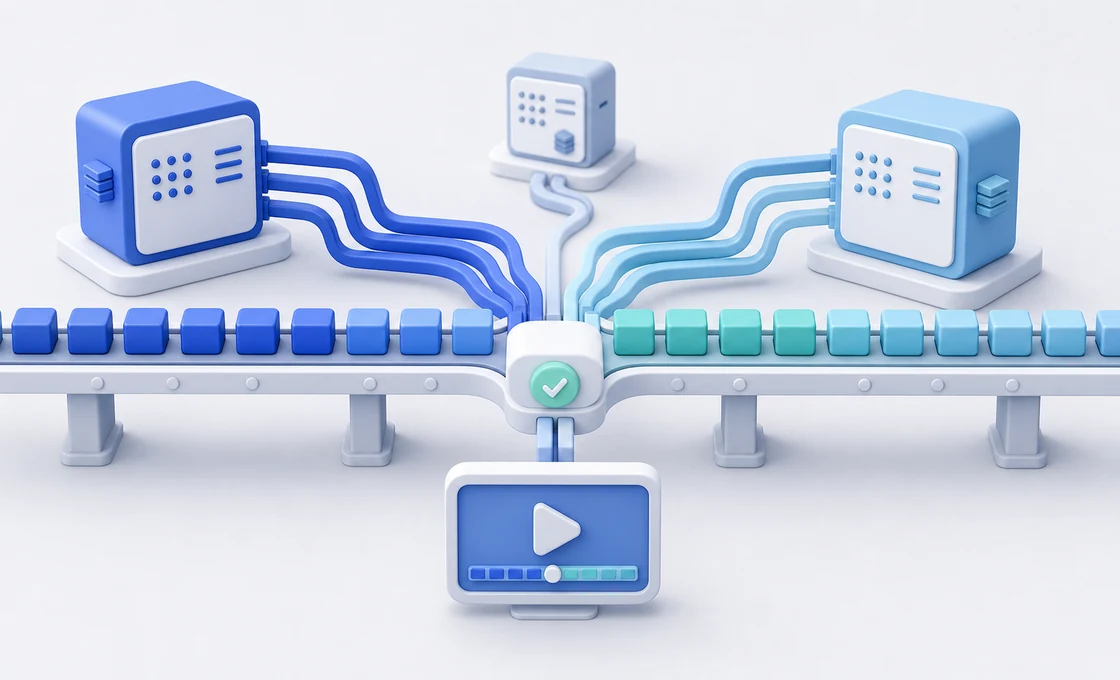
The CDN for a viewer is picked before playback starts, from what we already know about their geography and network. Then the brain stays on that session: it keeps reading what the viewer is actually getting, and moves them the moment their CDN starts to fail them. Most systems decide once, at the first segment, and never revisit — so a live event that goes wrong in the middle stays wrong for the rest of the stream.

What the viewer experiences

Nothing. The change lands on a segment boundary, so playback continues without a stall, a re-buffer or a visible quality drop.

What triggers it

The player's own reported buffer level and bitrate, plus what the serving CDN says about itself — not a guess from a synthetic probe in a data centre.

What it protects

Session affinity and no-switch windows stop the system from flapping, and SCTE-35 markers are respected so a switch never lands in the middle of an ad break.

Covered by a granted US patent family on server-mediated CDN selection and mid-stream switching.
The signals

Everyone gets the same data.
The brain is what you do with it.

The player already reports how it is doing. The CDN already answers back. Nothing here is exclusive to us — and nothing here is a decision. The decision is ours: for this viewer, on this network, right now, which CDN feeds the next segment.

CMCD — CTA-5004

Common Media Client Data. The player attaches what it is actually experiencing to each request, so the routing decision is made from the session rather than about it.

  • Buffer length and measured throughput
  • The rendition the player chose
  • Whether the session stalled, and for how long
  • A one-line embed where a player cannot emit it
The standards we speak

CMSD — CTA-5006

Common Media Server Data. The CDN answers back on its own responses, which is the only first-hand account of how the delivery side is actually holding up.

  • Whether the object was a cache hit
  • How loaded the serving node is
  • The round-trip the CDN itself saw
  • Our own measurement where a CDN stays silent
The standards we speak
Architecture

We watch every viewer. We carry none of them.

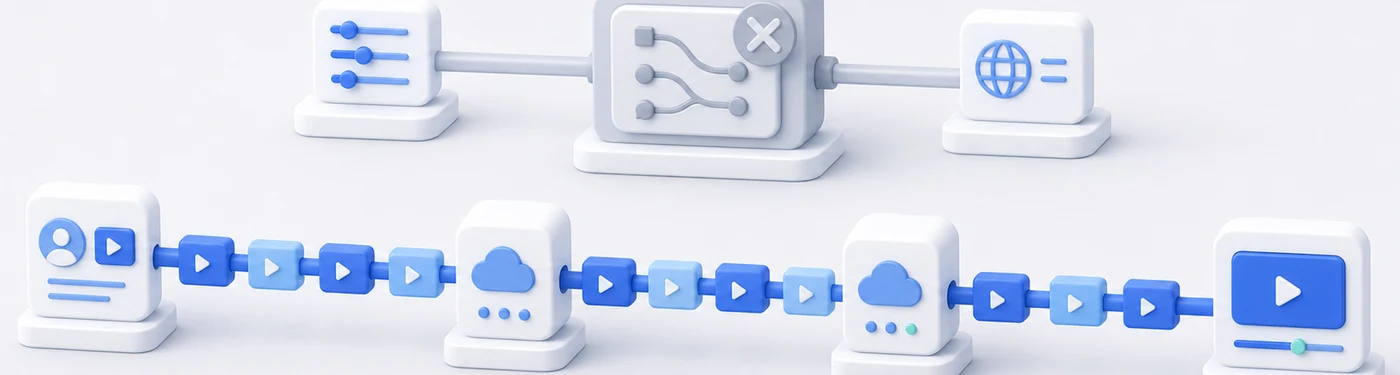
vidNT decides for every single session and still adds zero delivery risk: not one byte of your video passes through us. Your CDNs serve every viewer, exactly as they do today.

Your CDNs serve the manifest

Not us. The playback path never passes through vidNT.

Decisions are published ahead of the request

Into DNS and into Content Steering, so the answer is already in place when a player asks.

If we go dark, nothing stops

The last published decision stays in force. You lose new decisions, not the stream.

The decision layer sits beside the delivery path, never inside it
Deployment

Two ways to run it.

The product is the same either way. What changes is who operates it and where your viewers' data comes to rest.

Managed by vidNT

We operate the platform. Nothing to install, nothing to patch. The fastest way to get a first service routing.

  • No infrastructure on your side
  • We handle upgrades and availability
  • Fastest path to a first routed service
Request access

In your cloud (BYOC)

The platform runs inside your own cloud account. Your keys, your retention policy, your network boundary.

  • Viewer data stays in your account
  • Outbound connection only — no inbound holes
  • You hold the encryption keys
Request access
Where the CDNs come from

Bring your own — or get them through us.

Bring your own

The classic path. Connect the CDN accounts you already have — your contracts, your rates, your relationships stay exactly as they are. vidNT stitches across them.

CDNs included — through vidNT

No CDN contracts yet? One agreement with vidNT, and delivery runs on sub-accounts we hold with leading CDNs — priced by our combined volume, stitched by the same AI brain. Start on one, add more as you grow.

Getting started

Bring the setup you already have.

Whether that is a multi-CDN vendor, weights in a DNS console, a list inside your player, or something your team wrote — you should not have to retype it.

Works with

Your CDNs, your players, your DNS.

Three things have to be true for steering to work at all. All three of them are already yours.

CDNs

VIDNT works with the providers you are already contracted with. Which ones we can drive directly, and how deeply, is a live list — ask us for the current matrix rather than trusting a logo wall.

Players

Anything that can emit CMCD and follow Content Steering: common web players, native players, and your own if it speaks the standards.

DNS

The Content Steering manifest is published through the DNS you already run, so there is no new authoritative service to migrate to.

What people come to us for

Four situations, four different reasons this matters.

Survive a peak event

Demand arrives faster than any single CDN was provisioned for. When one starts to strain, VIDNT moves viewers individually — including sessions already playing — before anyone notices.

Relevant capability: mid-stream switching.

Cut rebuffering

Your dashboards are green and your viewers are complaining. That usually means the problem lives in one network, in one city — exactly the resolution a regional average erases.

Relevant capability: region × network routing.

Control delivery cost

You hold committed volumes across several CDNs and no practical way to hit them deliberately. VIDNT can weigh cost alongside quality — and shows you the trade before it takes it, never after.

Cost is an input to routing. It is never billed by us — see pricing.

Stop depending on one CDN

A second CDN only helps if something can actually move traffic to it while an event is live. A contract is not a failover plan.

Relevant capability: out-of-path publishing.

See it against what you run now.

The fastest honest answer is a comparison with your own stream, not a feature table.

Works with

Built to sit inside the stack you already run.

We route between your CDNs, pass your DRM through untouched, and answer whatever player your viewers already use — no SDK and no plugin in your player.

CDNs we route between

DRM & security we pass through

Players we tune for

Any player that speaks HLS or DASH works. The names above are the ones we detect and tune for by default.

Questions we are asked

Before you talk to us.

Does VIDNT replace my CDNs?

No. VIDNT decides which of your CDNs serves each viewer; the CDNs still do the delivering. If you run a single CDN today there is nothing for it to choose between — the first step is a second provider, not a new product.

What happens if VIDNT is unavailable during an event?

Playback continues. Decisions are published into DNS and Content Steering ahead of the request, so the last published answer stays in force. You stop getting new decisions; you do not stop delivering. How that works.

Do I have to change my player?

Usually a configuration change rather than a code change — most modern players can emit CMCD and follow Content Steering once they are told to. Where a player cannot, a one-line embed turns CMCD on from outside it.

How is this different from weighting a DNS record?

A weight moves a share of sessions and can see none of them. It cannot tell that one mobile network in one city is struggling, and it cannot move a viewer who has already started playing. Per-viewer routing · mid-stream switching.

Where does viewer data live?

That is what the deployment choice decides. Run it in your own cloud and raw session data never leaves your account, under your keys, on your retention policy. Both deployment models.

Which CDNs can you drive?

Ask us for the current matrix. We deliberately do not print a provider list on this page: naming one implies a relationship, and the depth of control genuinely differs between them.

How it works

Four moving parts — and you already own two of them.

Yours

Your CDNs

Whoever you are contracted with today. We add to them; we do not replace them.

Yours

Your players

They emit CMCD — often with a one-line change, sometimes with none at all.

vidNT

The decision engine

Scores every CDN per region and network, continuously, from live signals.

vidNT

The publishing layer

Writes those decisions into DNS and Content Steering, ahead of the request.

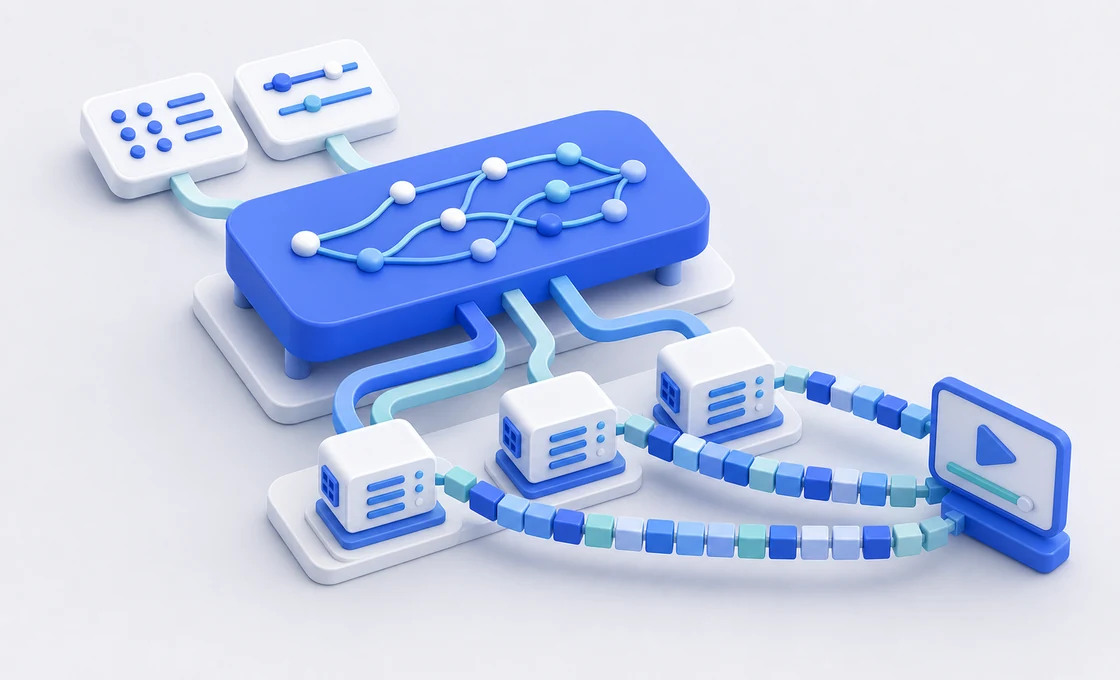
A viewer holding a phone; several CDNs each push their own colour-coded chunks into her one continuous stream
The platform, at a glance

Everything an operator expects. Plus the brain.

AI Stitching Brain

A decision per viewer, per chunk
Learns in-server from every session

Out of the Critical Path

Your CDNs serve the manifests
If vidNT stops, playback continues
No new single point of failure

Standards-Native

CMCD · CMSD · Content Steering · SCTE-35
Works with players as they are
No proprietary plugin, ever

API First

Full REST API — the console is just another client
OpenAPI docs · scoped API keys · webhooks on every event
MCP interface for AI agents (beta)

Security

Signed URLs survive the mid-stream switch
AES-128 with authenticated key delivery
SSO (OIDC) · immutable audit logs

Analytics at Every Level

Fleet → region → network → session → chunk
Every routing decision accounted for
Privacy rules built into the pipeline