
The AI‑NativeMulti‑CDN Stitcher.
A CDN fails mid-match — your viewers keep watching. Better quality and lower cost from the CDN contracts you already have.
What you getYour viewers keep watching — even when a CDN fails.
Click the one you run today — switching is the easy part
Keep your CDNs and the contracts you already have. We read what you run today and recreate it, and from then on every segment gets a per-viewer decision. Nothing moves until you say so.
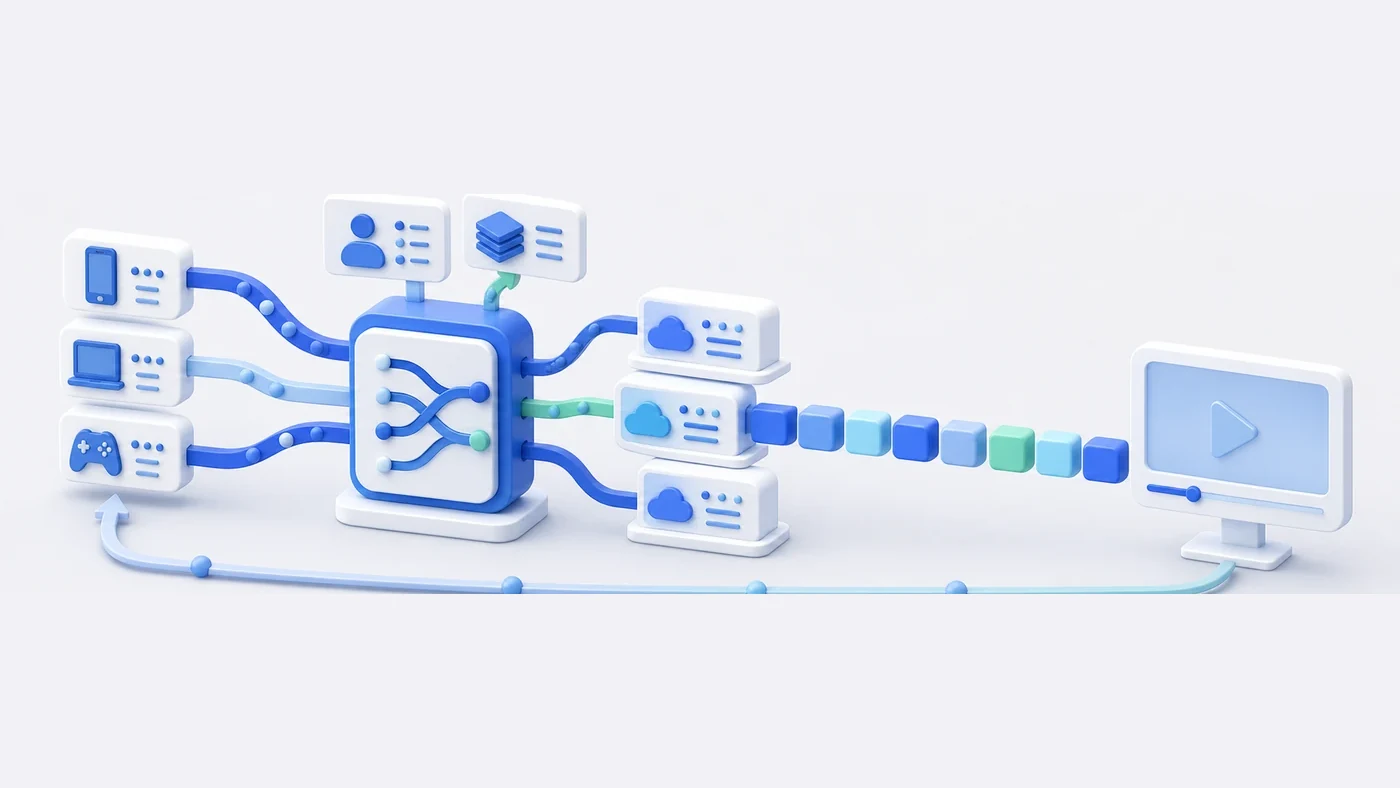
Every chunk on the viewer’s screen can come from a different CDN — stitched into one continuous stream. We run vidNT between two production CDN networks and break things on purpose. These are the measurements from that rig — real sessions, real CDNs, real faults.
“The industry needed a bridge between these two worlds.”
Will Law, Chief Architect at Akamai and co-chair of the CTA Common Media Server Data working group, on why CMCD exists — writing for DVB, October 2024. vidNT had already built that bridge, and patented it.
Our patents on mid-stream CDN switching were granted years before CMCD, CMSD and Content Steering were published. We speak all of them natively, including the extended CMCD field set — no custom SDK inside your player, no black box inside your delivery path.
Common Media Client Data. What the player reports upstream: buffer, throughput, errors. Version 2 (CTA-5004-A) was published in February 2026; our parser already reads its extended fields.
Read the specificationCommon Media Server Data. What the CDN reports back on every response — and the reason we can tell a slow CDN from a slow viewer.
Read the specificationHLS steering manifests exactly as Apple specifies them, and the DASH equivalent. This is how a player is told to take its next segment from a different CDN.
Read Apple’s HLS specificationAd and blackout markers preserved byte for byte, never rewritten away, and never switched across — we hold the source steady through a cue.
Read the SCTE standardPaste the playback URL of any live or on-demand stream. We read what is publicly there — nothing else — and tell you what your delivery looks like today.
No sign-up and no credentials. We store a hash of the URL, never the URL itself.
Check a stream in a few seconds, or import your current configuration and compare on paper before a single viewer moves.
Leave your details and we open your access. A person comes back to you within one business day.
Open your assistant with a ready prompt — ask it anything about multi-CDN stitching, how vidNT fits your stack, or how to start.
The prompt asks your assistant to read vidnt.com/llms.txt and answer from it.